
SaaS buying · Annotated contract review
Your SaaS Renewal Notice May Have to Go to a Customer Success Manager
A SaaS contract review checklist: ten clauses to read, each with the question to ask and the red flag, checked against real vendor terms and two free standards.
Last updated
The short answer
Read ten clauses, in this order:
- 1Renewal notice
- 2Renewal price
- 3Payment and suspension
- 4Changes to the terms
- 5The SLA remedy
- 6Data use and AI training
- 7What leaving costs
- 8The liability cap
- 9Logo rights
- 10Data export
Below, each has the question to ask, the red flag, and what real vendors write, next to the two free open standards, Common Paper and Bonterms. We are not lawyers, and this is a reading aid, not legal advice.
How to read this page
- 1A line in the document. Its note sits in the right margin, and on a phone directly under the excerpt.
- 2A note about the excerpt as a whole.
- underlineThe sentence the number rests on.
Read ten clauses, in this order
Each clause below is also a row in this checklist, with its question and red flag.
| Done | # | Clause and question | Red flag | Read |
|---|---|---|---|---|
| 1 | Renewal notice. How many days, sent to whom, in what form? | A notice that must reach a named role or a setting | Section 1 | |
| 2 | Renewal price. Is the increase capped? Does silence count as consent? | Then-current list price as the cap; deemed consent | Section 2 | |
| 3 | Payment and suspension. Late interest, dispute rights, cut-off notice? | Suspension while you dispute an invoice in good faith | Section 3 | |
| 4 | Changes to the terms. Can the vendor edit them by posting? | Changes at any time, with continued use as acceptance | Section 4 | |
| 5 | SLA. Which number, how to claim, only remedy? | Credits as the sole remedy; a claim window of days | Section 5 | |
| 6 | Data and AI training. What may the vendor do with your data? | Use for any business purpose; training with no opt-out | Section 6 | |
| 7 | Leaving. What happens to prepaid and unpaid fees? | Termination that accelerates the rest of the term | Section 7 | |
| 8 | Liability cap. Paid or payable? Which services? | Paid only; a cap tied to one service | Section 8 | |
| 9 | Logo rights. Can they name you? | Default-on logo use, including earnings calls | Section 9 | |
| 10 | Data export. Can you get your data out after the end? | Export that depends on a page you did not save | Section 10 |
We re-fetched the 13 vendor documents and both standards on October 19, 2026, and matched every quotation below against the saved page. An order form can override any of it.
1. Renewal notice: check who has to receive it
Bonterms (section 14.1) renews unless either party gives notice at least 30 days before the term ends. Common Paper (section 5.1) renews "unless one party gives notice of non-renewal to the other party before the Non-Renewal Notice Date", a date the standard terms do not define (section 13.24 says the Order Form holds the Variables they leave undefined).
Salesforce (section 12.2) and GitLab (section 4.2) use 30 days. HubSpot (section 4.2) gives no day count:
"you must turn off the auto-renewal setting in the Account & Billing section of your HubSpot account1 prior to the end of your Current Term"
Datadog (section 6.3) says the customer must do the following, or make the desired changes within the Services:
"Customer must submit a request to their Datadog Customer Success Manager1 at least 15 days2 before the expiration of the then current Order Term"
Days of notice, as each document states it
Datadog section 6.1 adds timing. For orders of 12 months or longer, it emails the Customer Administrator about 30 days before the renewal term starts, with any price change. That leaves about 15 days before the deadline, and the email goes to the Customer Administrator.
Datadog renewal dates, in days before the renewal term starts
- About 30 daysDatadog emails the Customer Administrator, with any price change (section 6.1)
- 15 daysLast day to submit the request (section 6.3)
- Term endsThe then current Order Term expires
2. Renewal price: neither standard sets one
Bonterms has no renewal pricing clause; section 12.1 says "Customer will pay the fees described in the Order". Common Paper's Standard Terms have none either, so any cap has to be written into the order.
| Vendor | Renewal increase | Section | |
|---|---|---|---|
| Salesforce | Up to 7% per unit, "unless We provide You notice of different pricing at least 60 days prior to the applicable renewal term" | 12.2 | 1 |
| Datadog | Up to "the greater of 9% or" the prior 12-month CPI change, on auto-renewals of orders of 12 months or longer | 6.2 | 2 |
| HubSpot | "up to our then-current list price", with at least 30 days' notice | 3.2 |
Salesforce also resets the price if you buy less. A renewal with decreased volume:
"will result in re-pricing at renewal without regard to the prior term's per-unit pricing1"
Datadog section 6.1 then says:
"Failure of Customer to take a non-renewal action in a timely manner, shall be deemed to constitute consent to the applicable fee increase1."
3. Payment and suspension: 1.5% a month is common
Bonterms (section 12.1) charges "1.5% per month or the maximum amount allowed by Law, whichever is less". Common Paper's payment section has no late charge. Salesforce (section 6.3) and Asana (section 4.1) also state 1.5% a month.
Suspension triggers vary. Bonterms (section 13) allows it once an account is 30 days or more overdue, with prior notice "where practicable". Common Paper (section 2.2) allows it for an undisputed balance more than 30 days old, "with or without notice".
Read what a dispute does. Salesforce section 6.5 says:
"We will not exercise Our rights under Section 6.3 (Overdue Charges) or 6.4 (Suspension of Service and Acceleration) above if You are disputing the applicable charges reasonably and in good faith1"
Snowflake section 6.3 holds off termination for cause and suspension for 30 days after you notify a Payment Dispute.
4. Changes to the terms: signed amendment or "at any time"
Both standards require a written amendment that both parties sign or accept (Bonterms section 22.6, Common Paper section 12.2). Online terms often go the other way.
Salesforce (section 14.3) says no modification is effective:
"unless in writing and signed by the party against whom the modification, amendment or waiver is to be asserted1"
Atlassian (section 20.9), for paid subscriptions:
"modifications to this Agreement will take effect at the next Order or renewal1"
The exceptions are mid-term changes for legal compliance or product updates, which you can object to by terminating within 30 days of the modification notice, with a refund of prepaid fees for the terminated portion.
Zoom (section 15.1):
"If you continue to use the Services after the effective date of the Changes, then you agree to the revised terms and conditions1."
Figma (section 9.1):
"Figma may modify these Terms (and any policies or agreements referenced in these Terms) at any time1."
Under Atlassian's terms, the renewal date is when most changes start to apply; under Zoom's and Figma's, a change can apply once it takes effect.
5. SLA credits: sole remedy, short claim window
Bonterms (section 7.2) defaults to commercially reasonable efforts at 99.9% a month if no SLA is named. Neither standard sets a deadline for claiming a credit. Vendors do.
Atlassian: you must file a support ticket to claim.
Snowflake: you must request credits.
Put the claim date in the same calendar as the renewal date.
6. Data use and AI training: the standards disagree
"Provider will access and use Customer Data solely to provide and maintain the Cloud Service1"
Common Paper section 1.6 goes the other way, if the data is aggregated and de-identified:
"Usage Data and Customer Content may be used to develop, train, or enhance artificial intelligence or machine learning models1" ... "commercially reasonable efforts consistent with industry standard technology"
Vendors sit on both sides.
"We may also use Customer Data to train our AI models1 in compliance with our obligations under the Agreement. You may opt out of having your Customer Data used for this purpose by updating your settings in your HubSpot account.2"
"may use aggregated or anonymized Customer Data and Usage Data for any business purpose1 during or after the term of this Agreement"
Check how Usage Data is defined, because a wide definition moves the line.
7. Leaving: where the prepaid money goes
We found no right to end a term early without cause in either standard. Atlassian gives one:
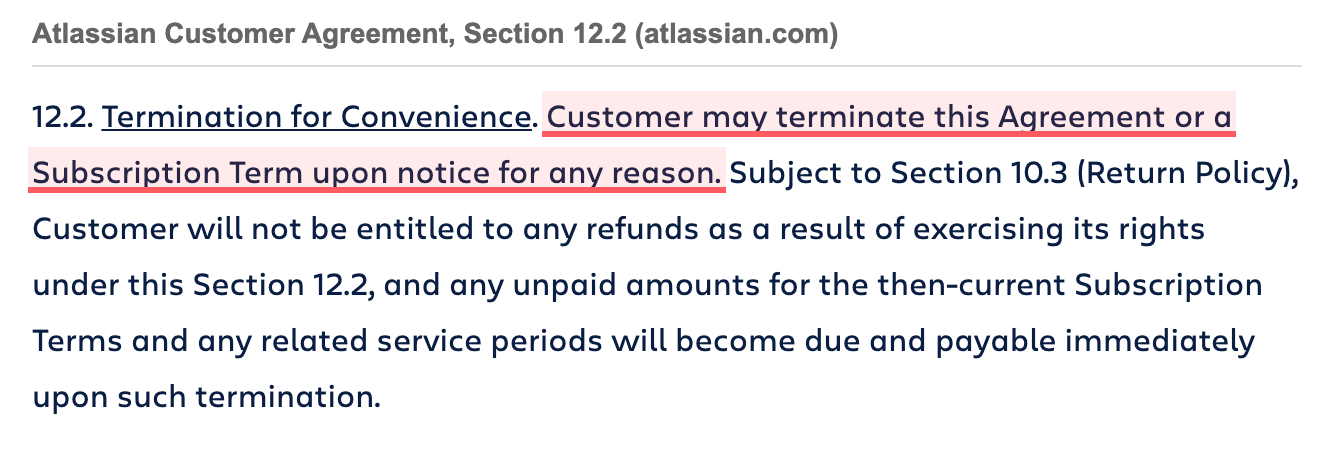
The cost is in the second sentence: "Customer will not be entitled to any refunds as a result of exercising its rights under this Section 12.2, and any unpaid amounts for the then-current Subscription Terms and any related service periods will become due and payable immediately upon such termination." Subject to the 30-day return policy in section 10.3, leaving early costs the rest of the term.
Salesforce (section 12.4) has the same shape when it terminates you for cause:
"You will pay any unpaid fees covering the remainder of the term of all Order Forms1"
If you terminate it for cause, it refunds prepaid fees for the rest of the term (section 12.4). For each way out, ask what happens to prepaid and unpaid fees.
8. Liability cap: one small word
Bonterms (section 16.5) defines the General Cap, with an Enhanced Cap for security and DPA breaches:
"amounts paid or payable1 by Customer to Provider under this Agreement in the 12 months immediately preceding the first incident giving rise to liability" ... "three times (3x) the General Cap2"
Salesforce (section 11.1) caps liability at:
"TOTAL AMOUNT PAID1" ... "THE SERVICES GIVING RISE TO THE LIABILITY2 IN THE TWELVE MONTHS PRECEDING THE FIRST INCIDENT"
Because it says paid, not payable, it leaves out fees that are due but unpaid, and it counts only the service that caused the loss.
Atlassian (section 14.4) caps a data-breach claim at "the lesser of: (a) two times (2x) the amounts paid" in the prior 12 months for the products involved, or US$5,000,000, so the dollar figure can only lower it.
9. Logo rights: the standards point opposite ways
"Provider may identify Customer and use Customer's name and logo in marketing1 to identify Customer as a user of Provider's products and services."
"Neither party may publicly announce this Agreement without the other party's prior approval1 or except as required by Laws."
"You grant us the right to add your name and company logo to our customer list and website1."
"You grant Twilio the right to use and display your name, logo, and a description of your use case(s) on Twilio's website, in earnings releases and calls1, and in marketing and promotional materials, subject to your standard trademark usage guidelines that you expressly provide to Twilio."
"neither Party shall refer to the identity of the other Party in promotional material1"
The Docusign clause applies unless an order form or written agreement says otherwise. Two of these three default to yes. Three documents are too few to call a market rate.
10. Data export: read the page it points to
Bonterms (section 14.4) allows export during a term "as described in the Documentation". We found no post-termination export right in either standard.
Salesforce (section 12.5) gives export on request:
"within 30 days after the effective date of termination or expiration1" ... "We will have no obligation to maintain or provide any Your Data2"
Atlassian (section 4.4) says only:
"The Documentation describes how Customer may retrieve its Customer Data from the Cloud Products.1"
When the contract points at the Documentation, save a dated copy of that page the day you sign.
Disclosure: AccountMade is built by The Plain Works. AI agents researched and drafted this piece.
Sources
- Datadog Master Subscription Agreement
- Salesforce Master Subscription Agreement (PDF)
- HubSpot Customer Terms of Service
- GitLab Subscription Agreement
- Asana Subscriber Terms
- Atlassian Customer Agreement
- Atlassian Service Level Agreement
- Snowflake Terms of Service
- Snowflake Support Policy and Service Level Agreement
- Docusign Master Services Agreement
- Twilio Terms of Service
- Zoom Terms of Service
- Figma Terms of Service
- Bonterms Cloud Terms v1.0
- Common Paper Cloud Service Agreement 2.1