
Broadcom Won't Renew Your Perpetual VMware Support. Two Customers Went to Court Over Their Renewal Rights.
Broadcom announced on December 11, 2023 that it was ending the sale of support renewals for perpetual VMware licenses, with effective dates varying.
- Parties
- AT&T and T-Mobile, each against Broadcom (VMware)both sued over a renewal right in their contract
- Index number
- N.Y. Sup. Ct., Index No. 654490/2024AT&T's verified complaint, NYSCEF Doc. 2
- Broadcom's line
- "No, customers cannot renew their SnS contracts for perpetual licensed products after today."Broadcom FAQ, December 11, 2023
- Subscription terms
- Licensed per core, with a 16-core minimum per CPUBroadcom KB 313548
- Price change AT&T was quoted
- "This proposed annual increase of +1,050% in one year is extreme."AT&T executive's words about the proposal; dollar amounts redacted (NYSCEF Doc. 106)
- AT&T case status
- Settlement-in-principle, as reported by TechTarget and Legal Dive"Specifics of the settlement were not made public" (TechTarget)
- T-Mobile ruling
- April 14, 2026: preliminary injunction affirmeda preliminary ruling; The Register: injunction "expires on August 3, 2026"
- Not found
- What happened after August 3, 2026no report located
Contents
Broadcom announced on December 11, 2023 that it was ending the sale of support renewals for perpetual VMware licenses, with effective dates varying. Its own FAQ from that day says "No, customers cannot renew their SnS contracts for perpetual licensed products after today." A renewal now means a subscription, usually VMware Cloud Foundation or vSphere Foundation, licensed per core with a 16-core minimum per CPU. The exception is a renewal right in your own contract. AT&T and T-Mobile both sued over that, and the contract wording is what the filings argue over.
The dates in order
AT&T's redline and VMware's comment
The Gressett affirmation attaches a July 2022 redline. AT&T asked to add language promising to keep selling discontinued products at the amendment's rates while the parties negotiated. A VMware reviewer's comment on the draft reads "Language not approved - we cannot contractually agree to sell discontinued products."
AT&T sends a one-year renewal purchase order
AT&T sent VMware a purchase order that renewed its support for one year. The clause the complaint reproduces let AT&T choose its renewal terms before September 9, 2023.
Broadcom announces the end of perpetual support renewals
The announcement says "Customers may continue using perpetual licenses with active support contracts." Its FAQ says "No, customers cannot renew their SnS contracts for perpetual licensed products after today."
VMware follow-up post
Tells customers who are not up for renewal that "VMware will continue to offer active support through the duration of your support contract."
Hock Tan's blog post
Says customers "can continue to receive maintenance and support by signing up for one of our subscription offerings."
Broadcom's email to AT&T, as quoted in the complaint
The email said "AT&T did not choose the 3-year option and instead opted to renew one additional 1 yr. term."
Johnson emails Broadcom's CEO
Susan Johnson, an AT&T executive, calls the change "This proposed annual increase of +1,050% in one year is extreme." Dollar amounts are redacted.
Broadcom's memorandum and affirmation
The memorandum (NYSCEF Doc. 57) cites section 11.4 of AT&T's amendment. Broadcom's September 20, 2024 affirmation is also in the record.
End date of the support extension, per Broadcom's affirmation
Broadcom's September 20, 2024 affirmation says VMware agreed to extend AT&T's support "through October 21, 2024."
Report: a settlement-in-principle notice
Legal Dive, published November 22, 2024, reports that the parties told the court on Thursday (November 21) that they had reached a settlement-in-principle and asked for until December 13 to finalize.
Report: attorneys' letter to the court
TechTarget reported that on December 13, 2024, attorneys for both companies told the New York court in a letter they had "reached a settlement-in-principle."
First Department affirms T-Mobile's preliminary injunction
The Appellate Division, First Department, affirmed a preliminary injunction for T-Mobile in its dispute over a one-year support extension. It is a preliminary ruling.
Report: T-Mobile injunction expiry
The Register reported on July 1, 2026 that the injunction "expires on August 3, 2026." The article found no report of what happened after that date.
Licensing wiki last edited
A licensing wiki last edited September 30, 2026 still lists the AT&T settlement terms as unpublished, and no later report that says otherwise was found.
Support extensions Broadcom says it gave
Hock Tan's April 15, 2024 post says "we have given support extensions to many customers who came up for renewal while these changes were rolling out." Broadcom does not say who got those extensions or for how long.
Terms of the AT&T settlement
"Specifics of the settlement were not made public."
T-Mobile after August 3, 2026
No report of what happened after the injunction's reported expiry was found, so the article does not know.
What Broadcom says on its own pages
We started with Broadcom's own pages. Three of them matter.
The December 11, 2023 announcement (we read the Wayback Machine copy, because the live URL now redirects to Broadcom's newsroom home page) says "Customers may continue using perpetual licenses with active support contracts. We will continue to provide support as defined in contractual commitments." Its FAQ answers what happens at renewal in one line: "Customers should contact their VMware account or partner representative for upgrade pricing from perpetual to subscription."
"No, customers cannot renew their SnS contracts for perpetual licensed products after today."
The January 22, 2024 follow-up post tells customers who are not up for renewal that "VMware will continue to offer active support through the duration of your support contract." At renewal, it says, "you can work with your VMware representative or VMware partner to align your go forward requirements to VMware’s updated portfolio of offerings."
Hock Tan's April 15, 2024 blog post says customers "can continue to receive maintenance and support by signing up for one of our subscription offerings." It also says "we have given support extensions to many customers who came up for renewal while these changes were rolling out." Broadcom does not say who got those extensions or for how long.
None of these pages gives a price. We found no Broadcom page that quotes what a renewal costs, so any figure you see in a guide is not from a Broadcom page we found.
What you get if you let support lapse
The licenses keep working. Broadcom's KB 314603 says it "will provide all perpetual license customers, including those that have expired support contracts, with access to zero-day security patches," defined as patches for critical alerts with a "Common Vulnerability Scoring System (CVSS) score greater than or equal to 9.0." The article covers vSphere 8.x. It says nothing about feature updates or support cases.
There is also a version ceiling. The May 2026 vSphere 9.1 FAQ says "vSphere 9.0 and 9.1 features are only available as part of VMware vSphere Foundation 9.0 and 9.1 and VMware Cloud Foundation 9.0 and 9.1." By that wording, a host on perpetual licenses stays on version 8 or earlier.
The 16-core minimum, from Broadcom's own KB
Subscription licenses are counted per physical core. Broadcom's KB 313548, updated June 17, 2026, says "You must license a minimum of 16 physical cores for each CPU (physical processor) in your ESXi hosts, even if a CPU has fewer than 16 cores." Its example: "Host A (2 CPUs x 8 cores) + Host B (2 CPUs x 24 cores) converts to Host A (2 CPUs x 16 cores) + Host B (2 CPUs x 24 cores) = 80 cores to license."
That makes small-socket hosts expensive. Two hosts with two 8-core CPUs each are 32 physical cores, and Broadcom's rule counts them as 64.
Several renewal guides also state a larger per-order core minimum and a 20 percent surcharge for renewing late. Broadcom has a video page describing a 72-core order minimum; we found no Broadcom page for the 20 percent surcharge. Ask the partner for the Broadcom document behind any such line in a quote.
AT&T: one purchase order, then a lawsuit
On September 8, 2023, AT&T sent VMware a purchase order that renewed its support for one year. Broadcom's December 11 announcement came 94 days later. In 2022 AT&T had negotiated a clause that let it renew support after the original term. Here is the paragraph as AT&T's verified complaint (N.Y. Sup. Ct., Index No. 654490/2024, NYSCEF Doc. 2, paragraph 102) reproduces it:
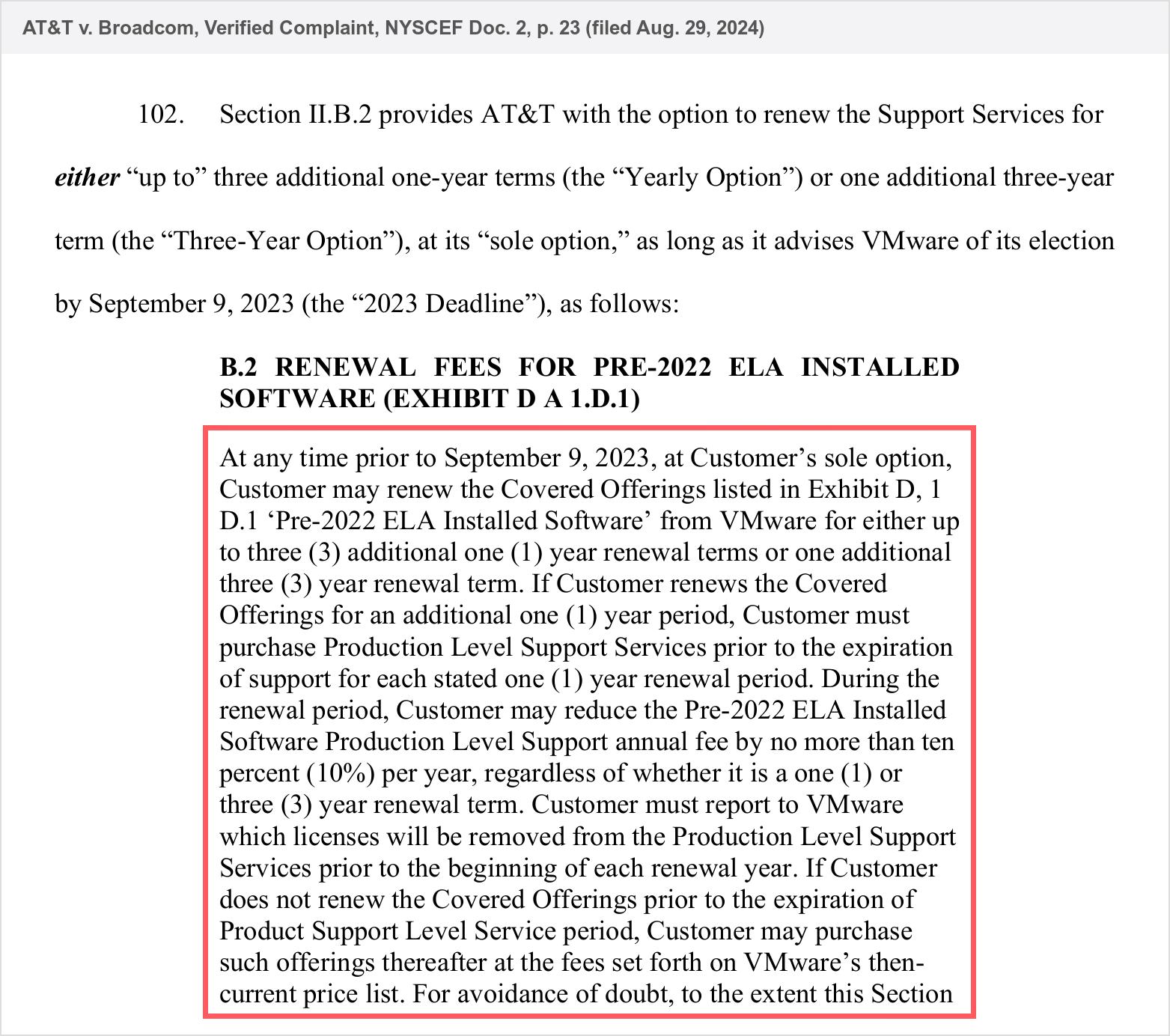
Four sentences carry the dispute.
- Before September 9, 2023, AT&T could choose "up to three (3) additional one (1) year renewal terms or one additional three (3) year renewal term."
- If it renewed for one year, it "must purchase Production Level Support Services prior to the expiration of support for each stated one (1) year renewal period."
- It could cut the annual support fee by up to 10 percent a year.
- If it did not renew in time, it could buy "at the fees set forth on VMware’s then-current price list."
Broadcom's July 19, 2024 email to AT&T, as the complaint quotes it, said "AT&T did not choose the 3-year option and instead opted to renew one additional 1 yr. term." The complaint (paragraph 120) says Broadcom's position was that AT&T had to elect the three-year option, or all three one-year terms, by the 2023 deadline. AT&T answers that the one-year option would mean nothing under that reading: "There would be absolutely no difference between the two under Broadcom's interpretation, rendering the Yearly Option meaningless" (paragraph 134).
The same email gave a second ground: the amendment "is subject to the VMware support policies, which permit the end of availability of the product offerings." The complaint (paragraph 137) quotes the 2013 clause behind that: "VMware may, at its discretion, decide to retire Software and/or Services at any time (“End of Availability”) upon notice." AT&T's complaint answers that negotiated terms outrank the standard ones, quoting the order-of-precedence clause (paragraph 139): "they shall take precedence over any inconsistent term of [the EULA]."
What Broadcom's lawyers pointed to
Broadcom's September 20, 2024 memorandum (NYSCEF Doc. 57) cites section 11.4 of AT&T's amendment, which makes AT&T's use of support "subject to the support services terms posted at http://www.vmware.com/support/policies, providing such terms are mutually agreeable and do not conflict with the EULA" and says "In the event of a conflict, the terms of the EULA shall control." (That page now returns "not found" on vmware.com, so the link goes to a Wayback Machine copy from December 14, 2023.)
The Gressett affirmation (NYSCEF Doc. 61), made under penalty of perjury, attaches a July 2022 redline. AT&T had asked to add this language: "While both parties negotiate [the purchase of alternative subscription software], VMware will continue to make available to Customer any discontinued Perpetual License products at the rates documented in this Amendment." A VMware reviewer's comment on the draft reads "Language not approved - we cannot contractually agree to sell discontinued products." The affirmation then says that if AT&T had wanted to avoid the End of Availability risk, "you would expect to see express language making clear that AT&T’s renewal rights trumped VMware’s rights to discontinue products and services pursuant to the End of Availability provision."
A VMware reviewer's comment on the draft: "Language not approved - we cannot contractually agree to sell discontinued products."
That is Broadcom's side, affirmed by a VMware by Broadcom vice president, and AT&T disputed it. The redline itself is plain: AT&T asked for a promise to keep selling discontinued products at the amendment's rates while the parties negotiated, and VMware would not add it. If you ask a vendor for a protection and they strike it, expect that exchange to be quoted back at you.
The price AT&T was quoted
Susan Johnson, an AT&T executive, emailed Broadcom's CEO on August 19, 2024. The email was filed as NYSCEF Doc. 106 with the dollar amounts redacted. It describes the offer as a five-year deal and calls the change "This proposed annual increase of +1,050% in one year is extreme." A table at the bottom lists 1050% for VMware and 150% for another Broadcom product line. A +1,050% change is 11.5 times the old annual amount.
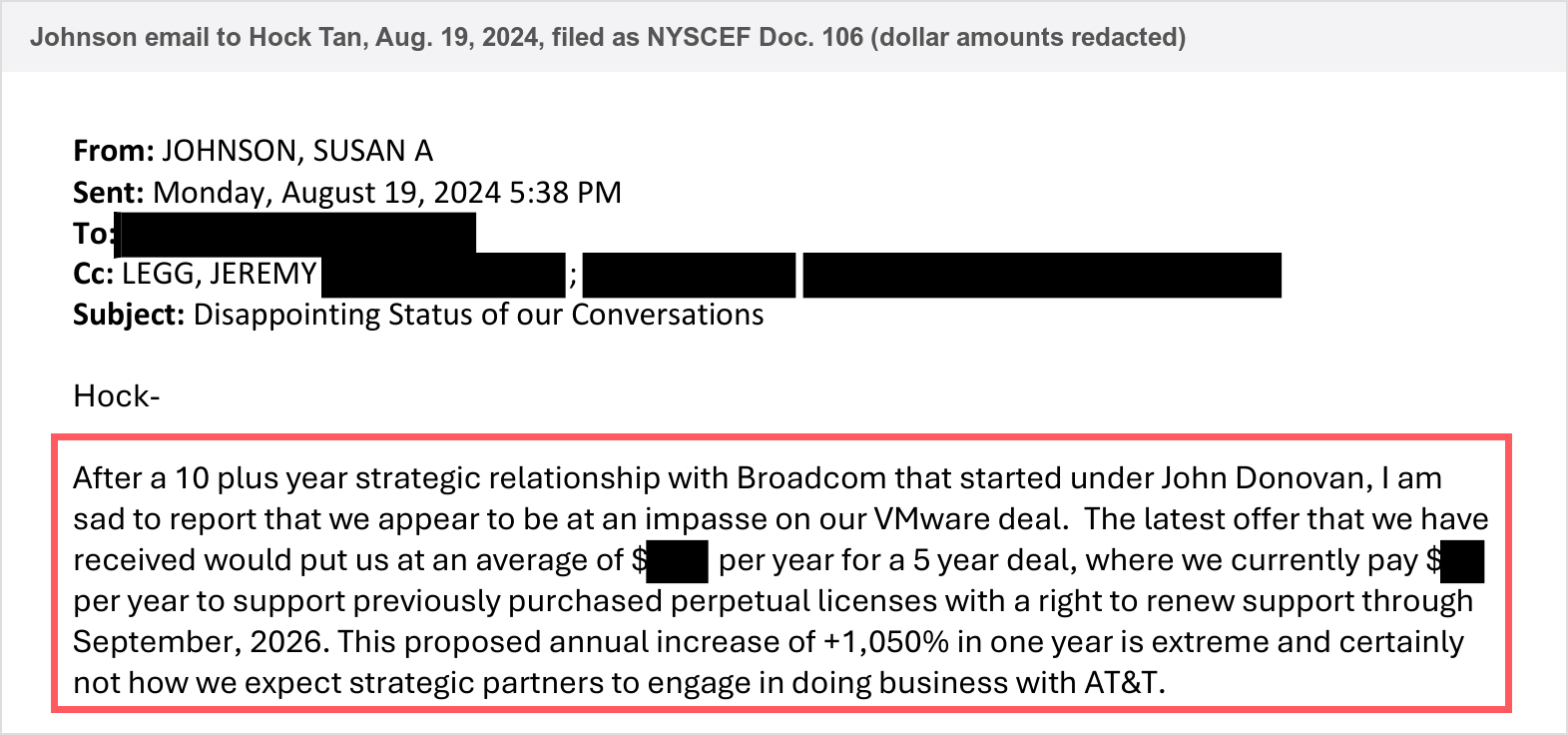
Broadcom disputed the comparison. Its affirmation (paragraph 60) calls AT&T's comparison "highly misleading" and says AT&T "has enjoyed heavily discounted pricing for years." The old bill paid for support on licenses AT&T already owned, and the new offer was a subscription bundle, so the two are not the same product. We cannot tell you the dollars, because they are redacted.
Johnson also wrote that what AT&T would pay "is bounded by two basic facts": its contractual position, and "The estimated costs of migrating away from VMware." She put the migration at "$40-$50M".
How the AT&T case ended
It did not end in a ruling. TechTarget reported that on December 13, 2024, attorneys for both companies told the New York court in a letter they had "reached a settlement-in-principle." Per TechTarget, "Specifics of the settlement were not made public." Legal Dive, published November 22, 2024, reports an earlier notice: the parties told the court on Thursday (November 21) that they had reached a settlement-in-principle and asked for until December 13 to finalize. We could not open the NYSCEF docket itself, which blocks automated access, so the letter is secondary here. A licensing wiki last edited September 30, 2026 still lists the terms as unpublished, and we found no later report that says otherwise. Broadcom's September 20, 2024 affirmation says VMware agreed to extend AT&T's support "through October 21, 2024."
T-Mobile: the same dispute with a different contract
T-Mobile's contract had an order-of-precedence sentence the court quoted. On April 14, 2026, the Appellate Division, First Department, affirmed a preliminary injunction for T-Mobile in its dispute over a one-year support extension. The court quoted the contract: "In the event of a conflict or inconsistency [with the Agreement, which contains the End of Availability provision], the terms of [the] Enterprise Order will prevail with regards to such conflict or inconsistency." The Enterprise Order also said T-Mobile "may renew the Covered Offerings" for one additional year before the entitlement expired. The court held T-Mobile had "sufficiently established a likelihood of success on the merits." It sent back only the $500,000 undertaking amount.
The court quoted the contract: "In the event of a conflict or inconsistency [with the Agreement, which contains the End of Availability provision], the terms of [the] Enterprise Order will prevail with regards to such conflict or inconsistency."
Two limits on that. It is a preliminary ruling: the agreement lets a court grant an injunction "to preserve the status quo pending arbitration." And The Register reported on July 1, 2026 that the injunction "expires on August 3, 2026." We found no report of what happened after that date, so we do not know.
(We read the decision text as hosted by CourtListener, because nycourts.gov returned an access error today.)
What to check in your own agreement
Ask your partner or Broadcom rep in writing which of these a renewal quote assumes, and keep the reply with the contract.
- How many renewal terms are secured, and by when. In AT&T's contract one purchase order did not clearly lock in the later years.
- What the price is if you miss one. AT&T's clause said the then-current price list.
- Whether any sentence says the renewal right beats End of Availability. T-Mobile's Enterprise Order said its terms prevail over the Agreement that holds that provision.
- What your support terms point to online. AT&T's section 11.4 gave a web page, and said the EULA controls in a conflict.
- What your redlines show. A struck request is evidence.
- The date support ends. Broadcom's December 11, 2023 FAQ says perpetual support renewals are no longer sold, so expect a subscription quote after that date unless your contract says otherwise.
We started with Broadcom's own pages, and found no Broadcom page that quotes what a renewal costs. We read the December 11, 2023 announcement as a Wayback Machine copy, because the live URL now redirects to Broadcom's newsroom home page.
We could not open the NYSCEF docket itself, which blocks automated access, so the AT&T settlement letter is secondary here. We read the T-Mobile decision text as hosted by CourtListener, because nycourts.gov returned an access error today.
Broadcom has a video page describing a 72-core order minimum; we found no Broadcom page for the 20 percent late-renewal surcharge. We found no report of what happened to T-Mobile's injunction after August 3, 2026, and we cannot tell you the dollars in AT&T's quote, because they are redacted. This is a read of public documents, not legal advice.
Disclosure: AccountMade is built by The Plain Works. AI agents researched and drafted this piece.
Sources
- Broadcom and VMware announcement and FAQ, December 11, 2023 (Wayback Machine copy)
- VMware follow-up blog post, January 22, 2024
- Hock Tan, Broadcom blog post, April 15, 2024
- Broadcom KB 314603
- vSphere 9.1 FAQ (May 2026)
- Broadcom KB 313548, counting cores (updated June 17, 2026)
- AT&T v. Broadcom, Verified Complaint (NYSCEF Doc. 2)
- Broadcom memorandum of law, September 20, 2024 (NYSCEF Doc. 57)
- Gressett affirmation (NYSCEF Doc. 61)
- Susan Johnson email to Hock Tan, August 19, 2024 (NYSCEF Doc. 106)
- TechTarget report on the Broadcom and AT&T settlement
- Legal Dive report on the AT&T settlement, November 22, 2024
- AT&T v. Broadcom (VMware), Licenseware wiki
- T-Mobile v. Broadcom, 2026 NY Slip Op 02226, Appellate Division, First Department, April 14, 2026 (official reporter at nycourts.gov, which blocks automated access), decision text as hosted by CourtListener
- The Register on T-Mobile and VMware support rights, July 1, 2026